Do you have a mold problem in your attic? What are the possible causes of this mold, and what damage could it do to your home? What are the possible solutions, and do you need attic mold removal? This guide answers those questions: in most cases, attic mold comes from moisture that condenses in winter because it is not exhausted, sometimes from water infiltration through the roof, and often from several combined causes.
Here is what this mold guide covers, in order.
- The causes of mold: moisture sources and ventilation defects · why the problem mostly occurs in winter · when the water comes from outside
- Mold symptoms and risks: how to recognize attic mold · some of our completed work · the dangers of untreated mold
- Mold removal solutions: the six-step approach · what mold removal costs · how to choose your contractor
- To learn more: frequently asked questions about mold removal
Causes of attic mold problems
The causes of mold growth in the attic can be multiple, independent or combined. It is important to analyze three key points in every mold diagnosis: the sources of moisture, the paths that let humid air rise from the house, and the effectiveness of the attic ventilation, whose purpose is to renew the air in order to dry out the attic. Excess moisture is often what triggers mold, while ventilation regulates and exhausts any surplus moisture. Here are some of the most common causes of attic mold:
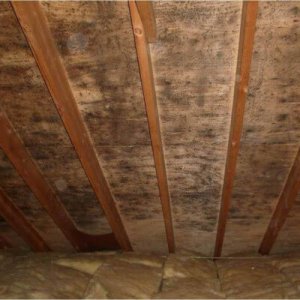
- Sources of moisture in the attic:
- Water infiltration through the roof;
- An exhaust that vents into the soffit or directly into the attic (e.g., a kitchen range hood or a bathroom fan vented into a soffit);
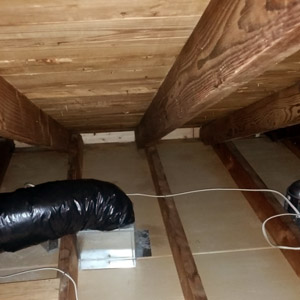
- Equipment ducts that run through the attic (furnace, air exchanger, etc.);
- Excessive humidity level in the house.
- What lets humid air rise or cools surfaces, and promotes condensation, then mold:
- Air leaks from the ceiling into the attic: unsealed access hatch, recessed light fixtures, plumbing, wiring or chimney penetrations;
- Deficient vapour barrier;
- Lack of insulation, which promotes condensation.
- Attic ventilation problems that promote mold:
- Soffits blocked by insulation or wood;
- Missing or insufficient exhaust vents at the top of the roof (ridge vents or Maximum-type roof vents) to remove moisture-laden air;
- An imbalance between air intake and exhaust: an exhaust vent added without enough air intake can put the attic under negative pressure and draw humid air from the house into it;
- A gable vent (sometimes a round, bull’s-eye-style vent) that was not closed off even though ridge ventilation is in place;
- A skylight or dormer that interrupts airflow between the soffit and the ridge.


Why the problem mostly occurs in winter
Depending on the temperature and humidity in the house, the warm air rising into the attic generally starts to condense (forming water droplets) as soon as the outdoor temperature drops below about 10 °C. The roof sheathing then reaches the dew point of that air: water settles on the attic wood, then turns to frost when the cold sets in (see our article on frost in the attic). If the moisture load exceeds what the ventilation can exhaust, or if the ventilation itself is deficient, these repeated cycles create conditions favourable to mold; once mold has set in, mold removal is generally required.
When the water comes from outside
 Infiltration follows a different logic: water enters the attic through the roof, a flashing, a poorly sealed vent or an ice dam, and wets the wood or the attic insulation at that spot, where mold can then develop. It is corrected first at the source, on the roof; ventilation alone does not fix it. The same house can have both condensation and infiltration, hence the importance of a complete diagnosis before any mold removal.
The ice dam illustrates this combination: heat escaping into the attic melts the snow on the roof, then the water refreezes at the colder edge and can back up under the shingles. An ice dam is therefore both a sign of heat loss and a path for infiltration, and thus a possible cause of mold. Our article on ice dam problems details its causes and solutions.
Symptoms: how to recognize attic mold
The colour of the wood is what tells the story: the plywood roof sheathing in the attic should be blond. When it no longer is, it is often a sign of mold: an ashy grey appears first, then gradually darkens until it turns black.
- The colour of the mold: at the very beginning, it looks like a smudged charcoal line.
- The location: mold often appears very close to a nail or a vent opening, or at the top or bottom of the roof.
- More advanced cases: more rarely, a blackening covered with white filaments, which corresponds to another strain of mold.
- The extent: the mold is either very localized or very widespread in the attic, and it is the level of contamination that determines the scope of the mold removal.
Other clues often accompany these mold stains: frost under the roof in winter, or ice dams along the roof edge, a frequent sign of heat loss into the attic.
If you recognize these signs of mold, our attic mold removal service identifies the causes and the steps to follow.
Some of our completed work (before/after)
Before and after photos of our attic mold removal work, with the main cause identified (other factors may have contributed) and the extent of the mold.


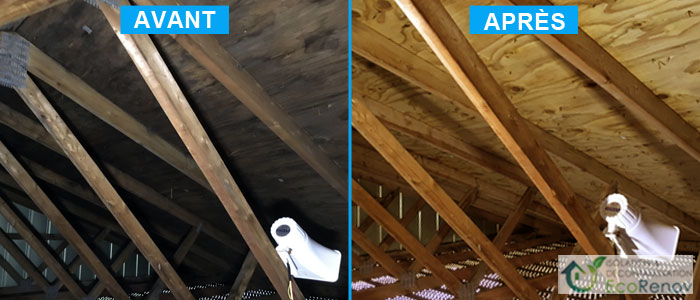

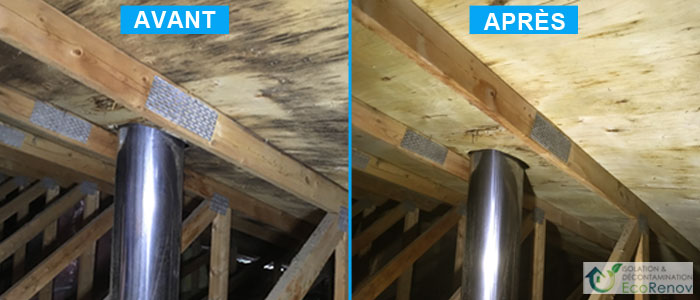
Stay at the attic access hatch and do not walk on the attic insulation. Do not move the insulation: in an older house, it may be vermiculite, which may contain asbestos. Respiratory protection is recommended, and no mold should be scraped or treated before the evaluation: clues about the cause of the mold would be lost, spores would be spread and the mold removal would be made more difficult.
The dangers of an untreated mold problem
Besides the possible effects of mold on the occupants’ health, documented by Health Canada, an attic mold problem left untreated can have the following consequences:
- Released mold spores can colonize the still-healthy sections of the attic: the mold may spread from one season to the next;
- The longer mold removal is delayed, the more the affected surface, and therefore the cost of the work, is likely to increase;
- As long as the moisture persists, it also promotes wood-rot fungi: over time, it can lead to rot of the roof sheathing;
- Rotting materials can affect the structural integrity of your roof and cause costly damage;
- Damp attic insulation loses its effectiveness and can retain mold spores;
- Several shingle manufacturers may reduce or refuse their warranty when attic ventilation is deficient;
- In a real estate transaction, an inspection report that flags attic mold can delay the closing until the mold removal is done (see attic mold and the resale value of your home).
What to do about an attic mold problem
Here, in order, is the mold removal approach we recommend to our clients.
Do not scrape or treat the mold yourself
Have the causes of the mold identified
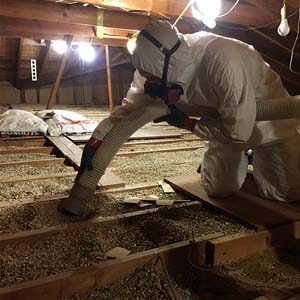
Have the mold removed properly
Correct each cause of the mold
Reinsulate after mold removal, if needed
Insist on proof of the mold removal
How much does attic mold removal cost?
At EcoRenov, attic mold removal generally costs between $800 and $5,000, depending on the extent of the mold and access to the attic; the cost of correcting the causes of the mold is added to the mold removal, depending on the work required. We do not charge a per-square-foot price backed by a minimum amount: the mold removal quote reflects your attic, and you receive it within 24 to 48 hours after the evaluation. For details, see our page on the cost of attic mold removal.
Attic mold removal near you: Montreal · Laval · Longueuil
How to choose your mold removal contractor
- A valid RBQ licence, verifiable on the Régie du bâtiment du Québec registry;
- Insurance that covers mold: at EcoRenov, $2M, mold endorsement included, with a certificate attached to every mold removal quote;
- Correction of the causes of the mold included in the quote, not just the decontamination of the attic surfaces;
- Experience in attic mold removal, backed by before/after examples of completed work;
- Expertise in attic ventilation, whose defects often cause mold: EcoRenov holds the advanced attic ventilation certification from Ventilation Maximum, recognized by the APCHQ;
- Proof provided during and after the mold removal (photos, certificate) and a written warranty with clear conditions, including labour and materials.
It is important to consult specialists in attic decontamination, attic insulation and mold inspection before the mold causes more serious damage. To get a diagnosis of your mold and a customized mold removal quote, feel free to contact us at 438-800-2046 or use our online form. EcoRenov Insulation & Decontamination: a team of experts specializing in attic mold removal and attic insulation in Montreal, Laval and on the South Shore.
Frequently asked questions about attic mold removal
Does the insulation need to be redone after mold removal?
Why is there frost in my attic in winter?
Why does mold come back after mold removal?
An inspection report flags mold in the attic. What should I do?
According to client reviews, EcoRenov means:
Your project, step by step
Our list of services related to attic decontamination





Request a quote for your attic mold removal project

More on mold and ice dams
When Should I Clear Snow Off My Roof?
Is your roof carrying too much snow? The telltale signs, the dangers of snow and ice buildup, and how to clear snow off your roof safely.
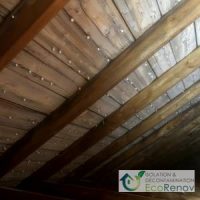
Frost in the Attic
Frost in your attic in the middle of winter? Ventilation, insulation, vapour barrier, access hatch: see where the moisture comes from and the everyday habits that make a difference.